Feminist Spatial Crafts Practice Share: Virginia Elyn Melnyk & Sara Codarin
Feminist Spatial Crafts Practice Share: Virginia Elyn Melnyk & Sara Codarin

We are pleased to invite you to the February Feminist Spatial Practice Share on Tuesday, February 20th at 12pm ET (zoom link here).
We have initiated the online Practice Share as a way to celebrate feminist spatial practices and connect with likeminded practitioners across the globe. In this session Virginia Melnyk and Sara Codarin are invited to present their practice, after which we will have a collective conversation mediated Renske Maria Van Dam.
This year we have organized our community program around four themes. We will kick-off with a focus on Feminist Spatial Crafts. Elaborating on the work of Virginia and Sara we will explore crafts or ‘craftsmanship’ in a feminist context by critically questioning assumed gender norms as well as by addressing the empowering potential of craftwork as a form of research, resistance and care.
Sara Codarin
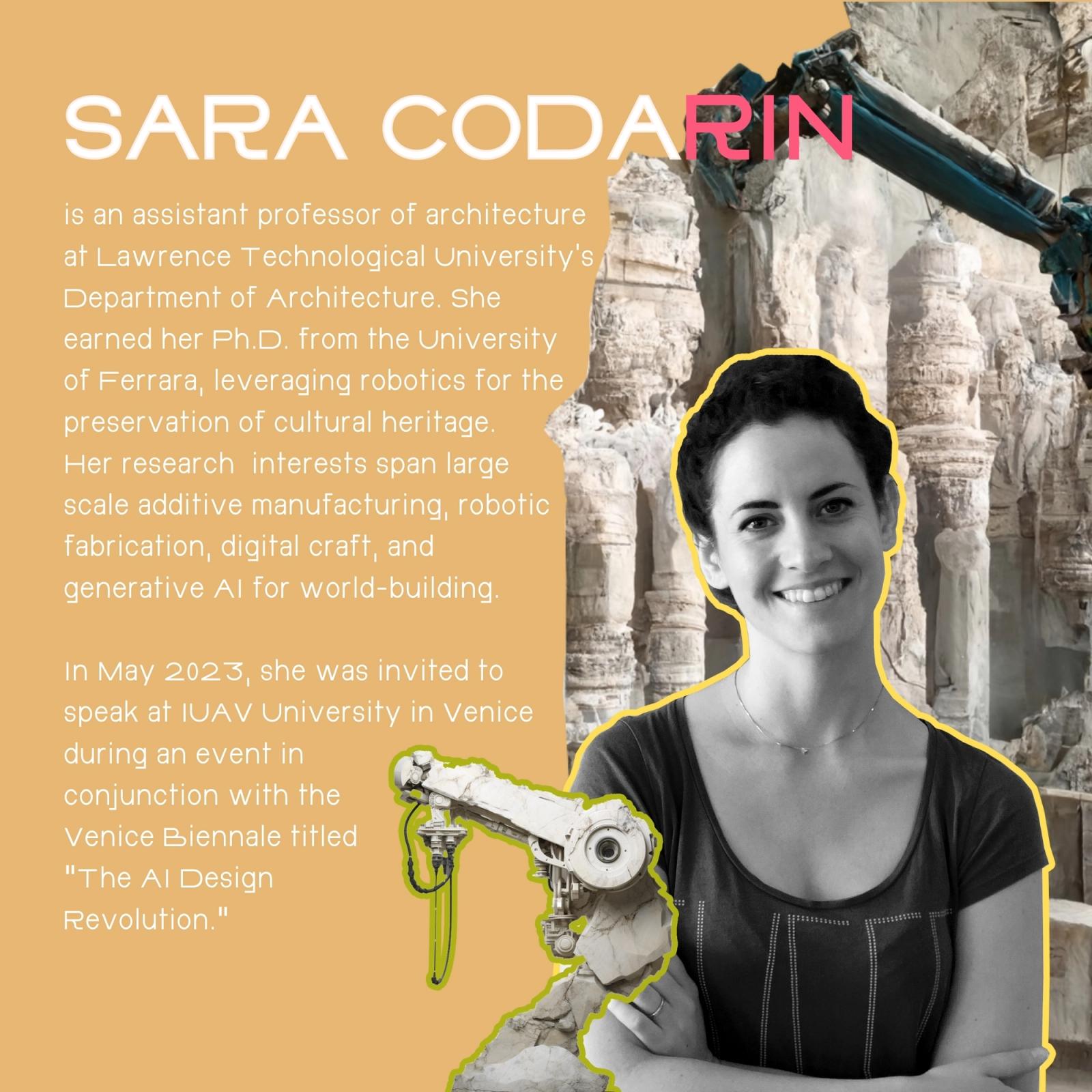
Sara Codarin is an assistant professor of architecture at Lawrence Technological University's Department of Architecture. She earned her Ph.D. from the University of Ferrara, leveraging robotics for the preservation of cultural heritage. Her research interests span large-scale additive manufacturing, robotic fabrication, digital craft, and generative AI for world-building.
In May 2023, she was invited to speak at IUAV University in Venice during an event in conjunction with the Venice Biennale titled “The AI Design Revolution.” She is a recipient of the 2022 Crain’s Detroit Notable Women in Design and Construction Award and the 2023 LTU’s Best Faculty Research Award.
As a member of the Detroit Month of Design community, she promotes the advancement of the technological culture in the metro area. In 2022, she showcased robotically fabricated 2.5D ink drawings at the Ford House, blending automation with one-off craft outcomes. Sara is a techno-optimist, and she loves robots.
Virginia Melnyk
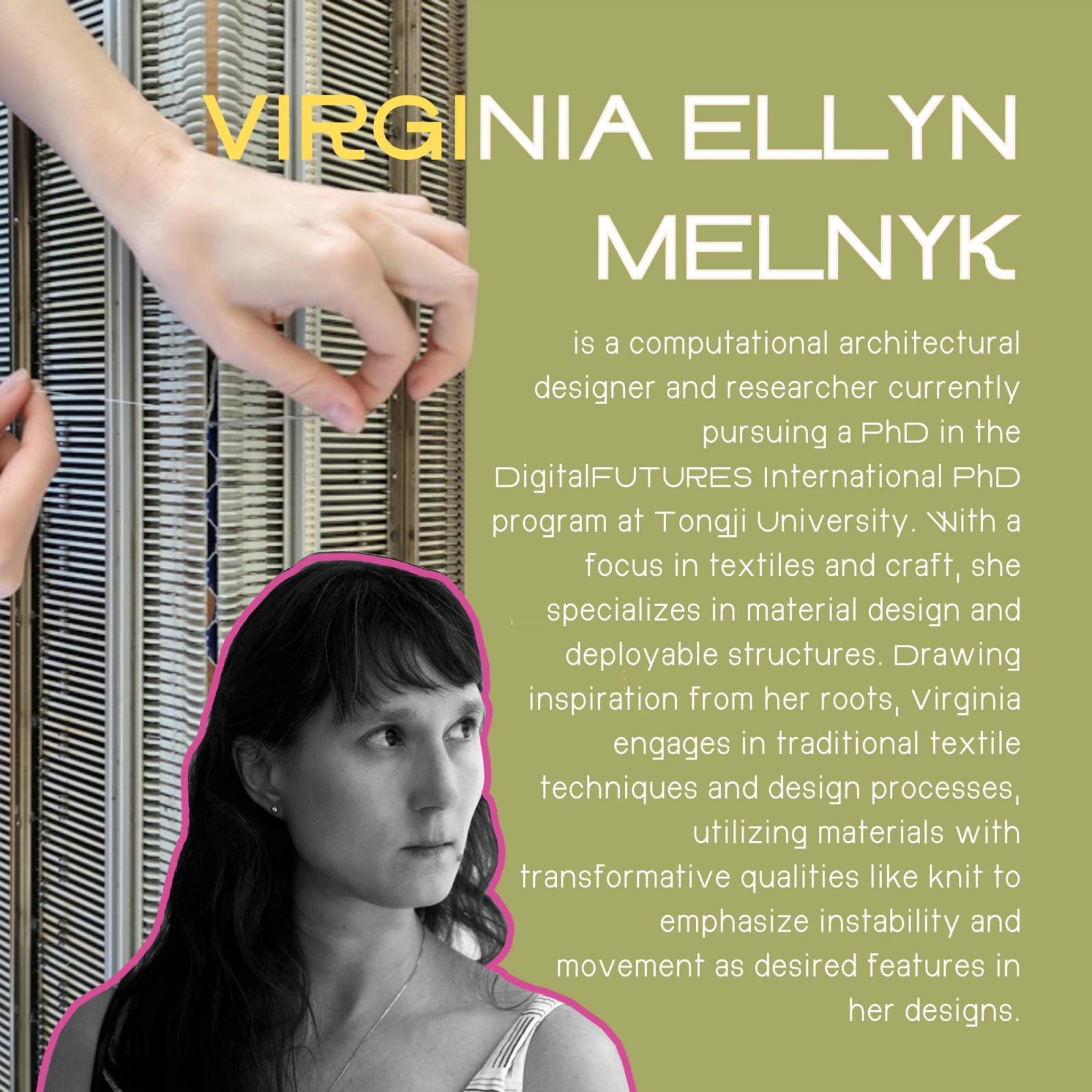
Virginia Ellyn Melnyk is a computational architectural designer and researcher currently pursuing a PhD in the DigitalFUTURES International PhD program at Tongji University. With a focus in textiles and craft, she specializes in material design and deployable structures. Drawing inspiration from her roots, Virginia engages in traditional textile techniques and design processes, utilizing materials with transformative qualities like knit to emphasize instability and movement as desired features in her designs. She believes that the adaptability and transformative capabilities of structures are vital for creating sustainable and innovative architectural solutions in the future.
Her research work pushes the boundary of installation art as she explores possible deployable designs at a human scale. She currently has an exhibition at Hanbury Architects in Richmond Virginia, and will also show her deployable knit hyperbolic towers at the Art Fields Festival in South Carolina later this year. She has also published and presented this work in many conferences over the past few years.
Virginia holds a Master of Architecture from the Weitzmann School of Design at the University of Pennsylvania and a Bachelor of Science in Architecture from the University at Buffalo. Her professional journey includes significant contributions to large-scale architectural projects while working at Studio Pei Zhu in Beijing.
Virginia's experiences in Tongji University and Beijing, enriched her teaching, providing her with opportunities to integrate the experiences of living and learning abroad and bring these insights into diverse architectural practices and trends worldwide.
She also actively volunteers at DigitalFUTURES and Feminist Spatial Practices. Which go beyond her academic and professional accomplishments, Virginia has demonstrated a strong commitment to teaching and mentorship. Her involvement with DigitalFUTURES and Feminist Spatial Practices suggests a dedication to community engagement and educational initiatives.
Virginia Ellyn Melnyk is currently the Foundations Fellow at Virgina Tech. where she has had the opportunity to develop curriculum which encompasses an interdisciplinary integration, bringing together her research in traditional craft and modern computational techniques. Her pedagogical methods are innovative, encouraging students to explore beyond conventional architectural boundaries through project-based learning, computational tools, collaborative design exercises, and experimentation at full scale with unconventional materials.